I know the ache of pouring yourself into Sunday after Sunday: praying, preparing, believing, and still feeling like the momentum just isn’t coming. I’ve lived through seasons when I’ve questioned my leadership, my calling and even my capacity.
If you’re an overwhelmed pastor, you may recognise that feeling. You’re carrying several kinds of responsibility at once, and another sermon or meeting doesn’t make the emotional load disappear.
Why do pastors feel overwhelmed? Pastoral ministry combines emotional care, community leadership, crisis response, organisational leadership and spiritual responsibility. My four practical responses are to resist self-pity, protect boundaries, enjoy positive distractions and cultivate ministry friendships.
The pressure is real. So is the possibility of building a more sustainable ministry life.
Steve Morrison’s experience of cumulative fatigue in ministry shows why accumulated pressure deserves attention.
Key Takeaways
- Pastors carry demands that overlap with several other professions.
- Your calling matters, but it doesn’t require you to be permanently on duty.
- Clear boundaries protect your time, energy and capacity to serve.
- Hobbies help you enjoy an identity beyond your ministry role.
- Friendships with other pastors help you carry the journey with support.
Understand Why Pastoral Ministry Feels So Heavy
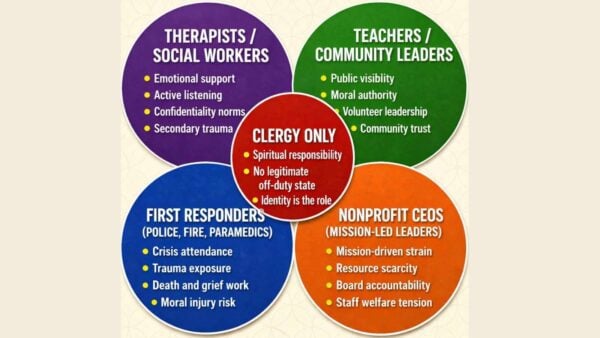
I saw a fascinating graphic shared by Valerie Ling on Facebook. It placed clergy in the middle of four areas: therapists, teachers and community leaders, first responders, and nonprofit CEOs.
Think about the overlap. Therapists offer emotional support, listen carefully, respect confidentiality and encounter other people’s trauma. Pastors carry many of those demands too.
Teachers and community leaders work with public visibility, community trust and moral authority. We also lead volunteers and live with the expectations that come with being known in our community.
First responders attend crises and encounter trauma. Pastors are often present when people face death and grief. Then there are the pressures familiar to nonprofit CEOs: limited resources, accountability to a board, staff welfare and the strain of pursuing a mission.
Add spiritual responsibility and the shepherding of people, and you begin to understand the weight. The graphic helped me name demands we can otherwise treat as one enormous, undefined burden.
I’ve explored that wider pressure in my article on why pastors consider quitting ministry. Recognising the load helps us respond honestly.
Separate Your Identity from Your Pastoral Role
One part of the graphic suggested that clergy have no legitimate off-duty state. I don’t agree with that. I believe you can have an off-duty state, and you should.
If being a pastor means you must always be available, where does that leave the rest of your life? Your vocation and calling can become so interwoven with your identity that you struggle to separate who you are from what you do.
I’ve discovered that hope rises when we stop trying to carry everything alone and start leading with clarity and intention. That includes being clear about when we’re working and when we’re resting.
You can care deeply about your church while allowing yourself time away from its demands. My article on how pastors’ holidays benefit their churches explores why stepping away can serve both you and your congregation.
Resist the Woe-Is-Me Response
My first practical response is straightforward: don’t start with “woe is me”. Acknowledging pressure is helpful. Deciding that nobody has it as difficult as you is a poor place to build your future.
Pastoral life also has benefits. Many pastors have flexibility in their working week: opportunities to work from home, take children to school or arrange their day. Conferences can provide professional development, travel and friendships. Your circumstances will vary, but it’s worth remembering the good alongside the demanding.
We responded to the call of Jesus and said yes. Remembering that helps me approach ministry with gratitude and responsibility.
And as I said to a pastor recently, when you’ve given a huge amount in serving the Lord, it’s not wrong to say it may be time to do something else as well. Honouring your calling includes being honest about your season.
Set Boundaries You Will Actually Keep
My second response is boundaries. You need the ability to say, “I can’t do that.” You also need to negotiate priorities when someone wants to add another project.
You can say to your board, “I can say yes to that project, but you need to tell me which other project I need to stop doing so I can say yes to it.” That makes the trade-off clear.
When I was pastoring, I told my team I expected them to be out one or two nights a week, with three as the maximum. Being out seven nights wasn’t something I required. I wanted them to stop treating constant activity as the normal rhythm of ministry.
For me, 36 hours with my phone off was a no-brainer. I wasn’t on demand 24/7. That was a boundary I practised, not merely an idea I admired.
Some people won’t like your boundaries. You still need them. If you don’t have a big no in your toolkit, these demands can demolish you.
Longer breaks also require preparation. The story of Brian Webber’s eight-week pastoral sabbatical shows how a church can share responsibility while its pastor rests.
Enjoy Positive Distractions Beyond Ministry
My third response is positive distractions: things you genuinely enjoy that take you out of your pastoral role for a while.
Over the years, I’ve enjoyed going to the gym, reading novels, photography and picking up my guitar. I’ve spent time in cafés reading the newspaper and writing about the scenes and little sagas I notice around me.
These activities let me say, “I’m not a pastor right now. I’m a photographer. I’m a reader.” They give me another part of life to enjoy.
Your activities might be swimming, walking, jogging or cycling. The point is to choose something you enjoy and make room for it. A hobby that never reaches your diary won’t offer much relief.
My reflection questions for church leaders can help you pause and ask what needs to start, what needs to stop, and how your energy and relationships are going.
Cultivate Friendships with Other Pastors
My fourth response is ministry friends. Find another pastor who is in the trenches, doing the work and navigating similar pressures.
I think pastors understand pastors better than anybody else does. There’s value in spending time with someone who understands the emotional care, leadership decisions and spiritual responsibility you carry.
Those friendships need cultivating. Make time for a coffee, a conversation or a shared activity. Don’t leave connection until you’re completely exhausted.
My experience of a cancer diagnosis showed me the importance of building pastoral friendships before a crisis.
You don’t have to overhaul your life this week. Begin with one boundary, one enjoyable activity and one invitation to a ministry friend. These are practical steps towards a pastoral life you can sustain.
Frequently Asked Questions
Why do pastors feel overwhelmed?
I see pastoral ministry bringing several roles together: emotional support, community leadership, crisis care, organisational leadership and spiritual responsibility. Their combined demands can leave a pastor drained.
Should a pastor always be available?
I don’t believe so. When I was pastoring, I protected 36 hours with my phone off. I believe pastors should have a legitimate off-duty state.
How can I say no to another church project?
I suggest making the trade-off clear: if you’re saying yes to a new project, ask your board which existing project should stop. Boundaries need practical decisions.
What hobbies help pastors unwind?
I’ve enjoyed photography, novels, the gym, guitar and time in cafés. Choose something you enjoy that helps you step outside your pastoral role.
Why are ministry friendships important?
I value friendships with pastors because they understand the work from the inside. Cultivate those relationships as a regular part of your life.