What’s our succession plan?
Who’s the next pastor?
What’s next for our church?
And what’s next for me as I hand over my church?
You will ask many questions in a succession process.
In recounting our story I hope to help many church leaders experience the same joy and pleasure we felt in our succession process.
A church succession planning process is complex and emotive. They bring out the best and worst in people but when done well they can be a season of inspiration and momentum.
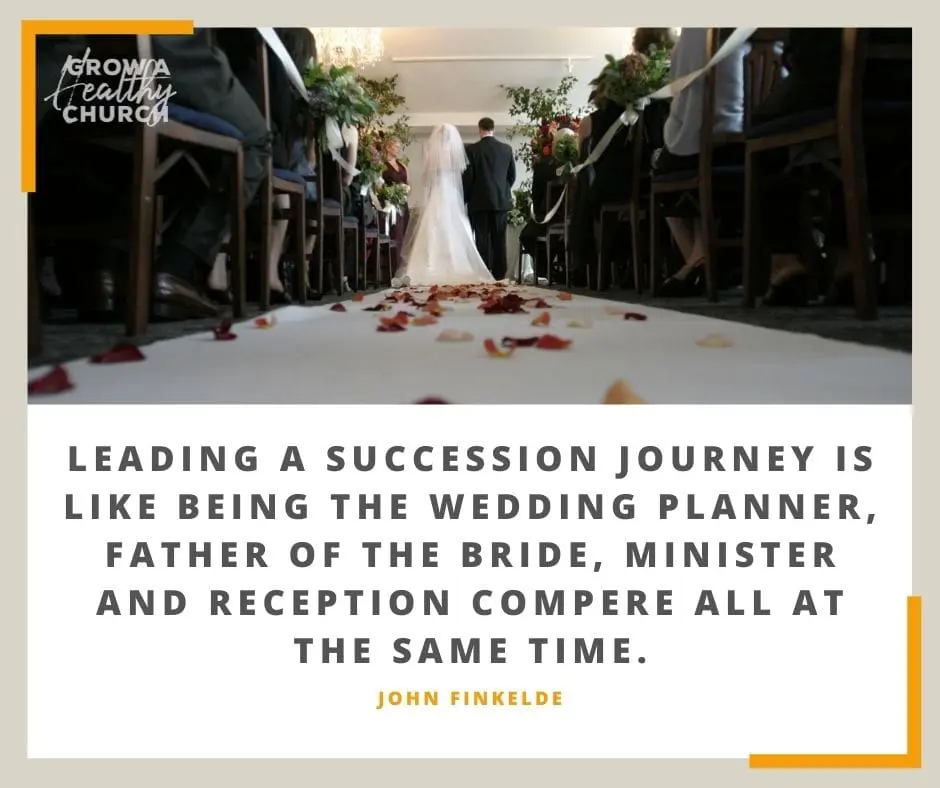
Leading a succession journey is like being the wedding planner, father of the bride, minister and reception compère all at the same time
WATCH
READ
What is Succession Planning?
My most succinct church succession planning definition is:
Succession planning is intentionally setting up the next generation for success while honouring the past.
A working church succession plan template
Copy this table into your planning document. Complete the owner, target date and status columns with your board and leadership team. My questions for church board members can help you clarify responsibilities and start useful conversations. The ten elements are explained in more detail below.
| Planning element | Decision or action required | Owner | Target date | Status |
|---|---|---|---|---|
| Philosophical framework | Agree on values, pastoral care and communication principles | To assign | To agree | Not started |
| Decisions to date | Record discussions, decisions and approvals | To assign | To agree | Not started |
| Search criteria | Define the qualities and experience needed in a successor | To assign | To agree | Not started |
| Timeline | Sequence the work and allocate responsibilities | To assign | To agree | Not started |
| Milestones | Identify key decision and transition dates | To assign | To agree | Not started |
| Incoming pastor learning plan | Plan mentoring, coaching and preparation | To assign | To agree | Not started |
| Communication schedule | Plan who hears what, when and from whom | To assign | To agree | Not started |
| Financial commitments | Document support, review dates and end dates | To assign | To agree | Not started |
| Transition responsibilities | Clarify how duties and authority will transfer | To assign | To agree | Not started |
| Post-handover involvement | Agree on the outgoing pastor’s future role | To assign | To agree | Not started |
Church leadership succession planning is one of the most significant and complex tasks a pastor will undertake in their ministry journey.
The succession process of handing over to a new pastor is a complex task especially when a pastor resigns after a long tenure.
Unfortunately, a church succession planning process is often avoided by churches, because of the complex challenges it presents.
Evasion and inaction are too often the order of the day as pastors grapple with this often-thorny issue.
Any church that faces the necessity of succession with proactive steps and appropriate attitudes will future-proof their church. They will ultimately enjoy the benefits of their diligence.
In October 2009, my wife Dianne and I initiated a succession process that began a unique and memorable journey. Overall, it took over three years and was deeply rewarding and arduous.
Our succession process, although not perfect, enabled us to move into a fulfilling future and ensured our church maintained its vibrancy and pioneering culture.
We have been able to establish a significant ministry to other churches. Our home church has been able to enjoy a fresh season of growth.
A Comprehensive Succession Plan
A vital initial step in achieving an effective succession is the development of a simple yet comprehensive and purposeful plan. Remarkably, many churches possess no such plan, relying on a combination of bravado and wishful thinking in journeying to and through succession.
A church can move confidently through the main issues when a lucid plan is in place. Implementing a succession plan that will ultimately benefit the church, its staff, and its members.
The Four Phases of Succession
A church succession plan template and plan will consist of four key phases.
The first phase is situation assessment which focuses on succession timing, the criteria for a successor and a preliminary list of candidates.
The second phase involves engagement with the church’s key stakeholders including the board, outside vested interests, and senior staff.
The third phase consists of the search for and selection of a successor.
The fourth and final phase is the implementation of the plan which is the crucial transition period.
The key players in the transition are the successor and the departing pastor.
The outgoing pastor’s primary aim should be to leave the organization in excellent condition and in the hands of the right successor.

Develop a Church Succession Plan
A comprehensive plan incorporates the key issues of succession while enabling a church to maintain a flexible approach to the process.
Consultants assisting non-profit organizations state that succession planning can prevent or significantly reduce the various problems that organizations face when a senior pastor departs.
These problems include
- decreased income
- waning staff morale
- confusion over organizational objectives
- program cutbacks
A good plan diminishes this kind of disruption to the church’s fruitfulness and to the staff.
It helps the board and senior leadership prepare for the future while alleviating stress about upcoming plans and directions.
Many pastors have neglected to develop church succession planning despite these significant benefits.
“Succession planning is so important, but no one is doing it.”
Donna Stark, director of leadership development, Annie E. Casey Foundation
Other studies indicate that the number of charities without succession plans is much higher. 86 percent of groups in the Kansas City, Missouri, area lack such plans, according to the Greater Kansas City Community Foundation.
When pastors neglect to shape a plan they can be caught short and underestimate the complexity of a succession. Never assume it will be a simple process.

Why do pastors avoid starting a succession process?
Pastors generally avoid church leadership planning because they are:
- fearful of becoming lame-duck pastors
- unsure how or where to start
- apprehensive about their future
- concerned that the succession process will hinder the church’s momentum
- threatened by the entire process
- anxious about losing power, privileges, and status
In succumbing to these fears, a pastor can ultimately stay in their role too long.
The church can suffer as it continues to operate in an outmoded style. It will lose its ability to take risks and its capacity to embrace change.
This avoidance strategy ultimately fails everyone, leading to disruption and higher levels of staff turnover.
Pastors must first shape their own attitudes and choices even before outlining a plan.
Committed to a Healthy Process
Dianne and I were always committed to never overstaying, leaving prematurely, or departing in haste.
We had an agreement that we would not leave our pastoral role until both of us were satisfied that it was the right decision.
I had been tempted to resign in despair more than once. We had seriously contemplated leaving the ministry for health reasons. However, we had outlasted these seasons and stayed the course.
We were keen to transition to the next phase of our life orderly. We wanted to give everyone appropriate time and space, as well as give us all the best chance of success.
Our heartfelt desire was to avoid the calamity of many church pastoral successions.
Denial was not an appropriate option.
We realized every pastor comes to the end of his or her tenure. We would leave satisfied if we could transition to the next generation of leaders with wisdom and grace.
Di and I Faced Our Fears
Together, we decided to confront our fears and insecurities.
Leaving a healthy church for the vagaries of life on the road carried enormous risk.
We assessed that risk and decided to jump.
The succession process would involve decisions and processes that at times would be emotionally sapping and overwhelming. Others had warned us that this would be the case.
Our own experience of being incoming pastors in a succession journey twenty years before had made us aware of the emotional pitfalls.
We did all we could to prepare our hearts and minds for the upheaval that invariably accompanies succession. Although you can never fully prepare yourself for the experience.
We Developed a Church Succession Plan Template
After thorough consultation with our board and movement leaders, I developed an exhaustive and comprehensive written plan.
I knew that verbal arrangements counted for little once the inevitable emotional heat entered the scene.
A written plan gave us all clarity and certainty through the choppy waters of succession.
What should be in a church succession plan?
1. The philosophical framework behind a succession journey.
The plan should include aspects of the philosophical framework.
Elements should include the
- Arduous and emotional nature of the journey
- Need for a comprehensive and written plan
- Pastoral care of both outgoing and incoming pastors
- Necessity of ensuring the outgoing pastor is honoured and empowered to develop a future after handover
- Ensuring the incoming pastor is properly supported and mentored into the lead role
- Vital importance of clear and regular communication with staff, key leaders, and members.
2. What has happened to date?
Discussions and decisions that have occurred before the formulation of the plan should be documented.
3. Search criteria.
The criteria for search for the incoming pastor.
4. Timeline
A detailed timeline should outline who does what, and by when.
5. Milestones
Key milestones should be noted in the plan.
6. Learning plan for incoming pastor.
A comprehensive learning plan should outline what mentoring, coaching, reading, and study is required of the incoming pastor.
7. Communication schedule.
A documented plan for communication is essential in a strategic succession plan.
This plan will include the sequence of major announcements. It will have the pre-written copy for all public announcements, emails, website, letters, and social media.

8. Financial commitments.
Any ongoing financial support for the outgoing pastor should be specifically documented.
Never leave this to the mercy of verbal agreements. All financial support should have review dates and sunset clauses.
9. Responsibilities of outgoing and incoming pastors during the transition.
During the transition phase, the outgoing pastor should increasingly hand over responsibilities to the incoming pastor.
The incoming pastor should take on more authority and power during the transition phase. However, the ultimate responsibility for leading staff and pastoring will remain with the outgoing pastor.
This gradual shift of responsibilities should be outlined as clearly as possible.
While it will be impossible to get this completely accurate, a plan will ensure that it does happen.
10. Post-handover involvement of outgoing pastor.
A sticking point in most, if not all, successions is the role and involvement of the outgoing pastor after the handover.
Never leave these key issues to the post-handover period:
- Staying in the church as a member
- Remaining on the board
- Staff role
Frank and open discussions well ahead of the handover date will ensure clarity and certainty for everyone.
A comprehensive strategic plan will future-proof your church. It will cause the church to move sequentially and purposefully through the four key phases of a successful succession process.
Frequently asked questions
When should a church begin succession planning?
Earlier than you think.
Succession involves people, relationships, leadership development and the future of your church. Those things take time.
Our succession process began in October 2009 and took more than three years. Your timetable may be different, but leaving it until the pastor is ready to depart creates unnecessary pressure.
Begin the conversation while you have time to pray, prepare and make thoughtful decisions.
Who should be involved in developing the succession plan?
The pastor and board need to work together, with the involvement of your denomination or movement where appropriate.
Check your church’s constitution and governance requirements. Be clear about who makes the decisions, who needs to be consulted and how the congregation will be informed.
Assumptions can cause considerable grief. Get the responsibilities clear before you’re deep into the process.
Is it better to appoint someone from within the church or bring in an outside pastor?
Either can work.
An internal successor may already understand the church’s culture and have the trust of its people. An external successor may bring experience and fresh perspective that the church needs.
The key question is whether the person has the character, calling and capacity to lead your church into its next season.
Familiarity alone is a poor reason to appoint someone. So is the appeal of a fresh face.
Pray, assess carefully and do your homework.
What if the pastor leaves unexpectedly?
Your church needs a plan for that possibility too.
Who will provide interim leadership? Who will arrange preaching and pastoral care? Who has authority to make decisions, and who will communicate with the congregation?
Work through these questions while things are settled. Write down the answers and make sure the relevant leaders know the plan.
An unexpected departure is difficult enough without adding confusion about who is responsible for what.
Should the outgoing pastor stay involved after the handover?
Sometimes that works well. Sometimes it makes the transition harder.
Agree on the outgoing pastor’s role before the handover. Clarify any preaching, mentoring, pastoral involvement or ongoing employment, and put the agreement in writing.
The incoming pastor needs room to lead. The outgoing pastor needs clarity about how to support that leadership.
Good intentions help, but clear boundaries give those intentions a chance to work.