The atmosphere was colder than an arctic winter. Palpable hostility was written all over some faces. Yes, that’s right. I was preaching on money.
It was the first series I’d ever done on the ‘forbidden’ topic and I was soon intimidated by the ‘cold as death’ atmosphere and dismissive looks from stakeholders in our church.
However, I refused to back down and thus began a long journey of learning how to disciple our church in this central element of their lives.
I know that preaching on money is one of the topics that pastors avoid and even hate. They would rather take a cold bath in the middle of winter than broach this delicate topic.
Here are 14 reasons why pastors don’t like addressing this topic.
Watch: Pastors and Money
In this video, I explore the fears, training gaps and personal financial struggles that make preaching on money such a difficult topic for pastors.
1. Fear of Failure
Money is one of the two topics pastors prefer to avoid. The other one? Sex.
Preaching on money is territory peppered with landmines which are hard to avoid.
When pastors get on this high wire they know that there’s a high risk of failure.
They could say the wrong thing, sound the wrong note, look the wrong way, or drop the ball because of nerves and the (occasional) hostile face.
Pastors don’t want to deliberately upset their members even though they know there are times when preaching biblical truth will afflict the comfortable.
They prefer to bring comfort and care than lifestyle disturbing truths.
2. Lack of Training
Pastors are well-trained in theology, interpreting the Scriptures, and pastoral care.
However, they often lack training around budgets, profit and loss reports, and fundraising.
I was never trained in how to go about preaching on money so when it came to this thorny topic I felt insecure.
I think most pastors are in the same boat. No one has shown them how to preach on money or what to say.
Uncertainty leads to indecision then procrastination sets up camp and ultimately avoidance rules the heart.
Pastors get discouraged and people are not discipled. These are terrible results.
3. They Don’t Want To Be That Guy Who Is Always Preaching on Money
That guy is a prosperity preacher.
That guy is a pastor who always prattles on about money.
That guy is the pastor who seemingly fulfils the proverb “the church is only after your money.”
And no pastor wants those labels.
While I have learned some excellent truths from prosperity preachers I don’t want to be one or be grouped with their kind.
Most pastors I know want to build a reputation of integrity and a culture of generosity and will avoid like the plague anything connected with ‘preaching to get rich.’
4. A Dearth of Financial Intelligence
The majority of pastors I know have not run businesses or been raised in a financially savvy family.
They’ve studied theology, the Scriptures, and pastoral leadership, not financial management.
They answered Christ’s call to ministry with a deeply ingrained desire to serve God and His people.
Invariably they discover that part of their role as a pastor is to raise resources to fund the vision Christ has given them.
Feeling ill-equipped for the task they bemoan their low levels of financial intelligence.
A pastor may be emotionally intelligent, spiritually alive, and theologically sound but a lack of financial intelligence will be a hindrance.
Being ignorant about cash flow, budgets, and profit and loss statements can create havoc in a church.
It’s difficult to lead an annual giving campaign if you are financially illiterate.
Over the years I’ve endeavoured to increase my financial intelligence by networking, reading, and becoming an investor. This journey has helped me no end as I’ve endeavoured to become more financially savvy.
Confidence in teaching about money grows as you develop your own financial understanding. My book Financial Intelligence for Church Leaders will help you build that foundation.
5. Fear of Rejection When Preaching on Money
Pastors don’t have a death wish.
They don’t love rejection. They abhor it. They go into ministry to love people and hopefully have that love reciprocated.
Preaching on money will guarantee some intimidating reactions.
People don’t want you messing around in their private financial world and trust me, money is a very private thing.
If you don’t believe me start asking your friends how much they earn and the size of their credit card debt and you will soon discover a simple way to lose friends.
Preaching on money is an eye-opener. People don’t realise how much you can observe when you’re ministering the Word. The reactions on faces and obvious body language send a message to every pastor.
Over the years I have improved my communication skills and find it relatively easy to now preach on finance, knowing that I am helping people with an important part of their world.

6. Naive Idealism
Without a doubt, faith and prayer are essential elements if you want to grow a healthy church.
However, idealistic pastors can be blindsided by relying entirely on faith and prayer to raise resources. They read the legendary tales of saints long ago who prayed ardently for the Lord’s provision and saw miraculous provision.
They don’t realise the multiplied benefits of following the best practices in church finances.
Thus the naïve pastor expects God to provide entirely through a response to fervent prayer and without them having to suffer the embarrassment of asking for money.
While I’ve experienced this type of supernatural intervention I’m not convinced that it is the only way we should approach resourcing Kingdom endeavours.
For example, Paul takes pains to prepare his churches for an offering for the needs of the Jerusalem church. He writes at length about this in 2 Corinthians 8 and 9 and I think gives us a good example of how to approach our church with special projects.
Paul sets a superb example for all pastors on the need to raise offerings for special projects. He does not step back out of fear or a super spiritual idealism.
Paul is a realist who knows he must establish the necessity of the need and remind people to fulfil their commitment to generosity. He even provokes the Corinthians by elevating the above-and-beyond endeavours of the Macedonians.
7. They Love Money
Do I love money?
Now that’s a good question to ask yourself now and again.
And if I answered truthfully, my answer would at times be Yes, I do love money.
I enjoy having savings in the bank, cash in my wallet, and investments yielding returns.
I love the options that money gives me.
I like the security that money provides and I don’t like the anxiety that accompanies lack.
The solution?
I observe how the love of money affects people. I’ve seen people chase after it to the detriment of their family and walk with Jesus. I have also been inspired as I’ve watched people use their money to help others in their time of need.
I seek to be generous on all occasions as I’ve found it to be a powerful antidote.
I ask the Lord to uproot my love of money out of my heart and look to serve Jesus, not money.
8. The Bible Posits Opposing Views
The Bible presents seemingly polar opposite views about money.
On one hand, we see giants of the faith like Abraham and David becoming exceptionally wealthy, and yet we see apostles like Paul making tents to raise resources for ministry.
Scriptures extolling the blessings of wealth are found in the same book of Proverbs as middle-of-the-road ideas such as, “Give me neither poverty nor riches but give me only my daily bread. Otherwise, I may have too much and disown you and say, ‘Who is the Lord?’ Or I may become poor and steal, and so dishonour the name of my God.” Proverbs 30:8–9.
We see Jesus instructing one rich man to sell everything he owned and give it to the poor while comparing wise disciples to wise investors.
It can be somewhat confusing and pastors know they have people sitting in their church who hold these polar opposite views. It turns a difficult task into a daunting one.
Turn your teaching into practical action. The money quiz will help you identify ways to strengthen your church’s approach to raising resources for its mission.

9. They Are Dishonest
It saddens me to write this but fraud and embezzlement occur in churches.
Yes, that’s right Christians rob the church of funds.
What makes me even sadder is that pastors are at times involved in this corrupt behaviour.
A pastor who steals church funds is unlikely to preach about money. However, when they do their guilt and shame generally push them into the harsh territory of legalism on money matters.
10. Uncertain How To Present A Need
Pastors can struggle with the right language, disposition, and approach when it comes to presenting a genuine and significant need.
Uncertain about their stance, they either apologise for asking or worse still they never ask and thus never receive.
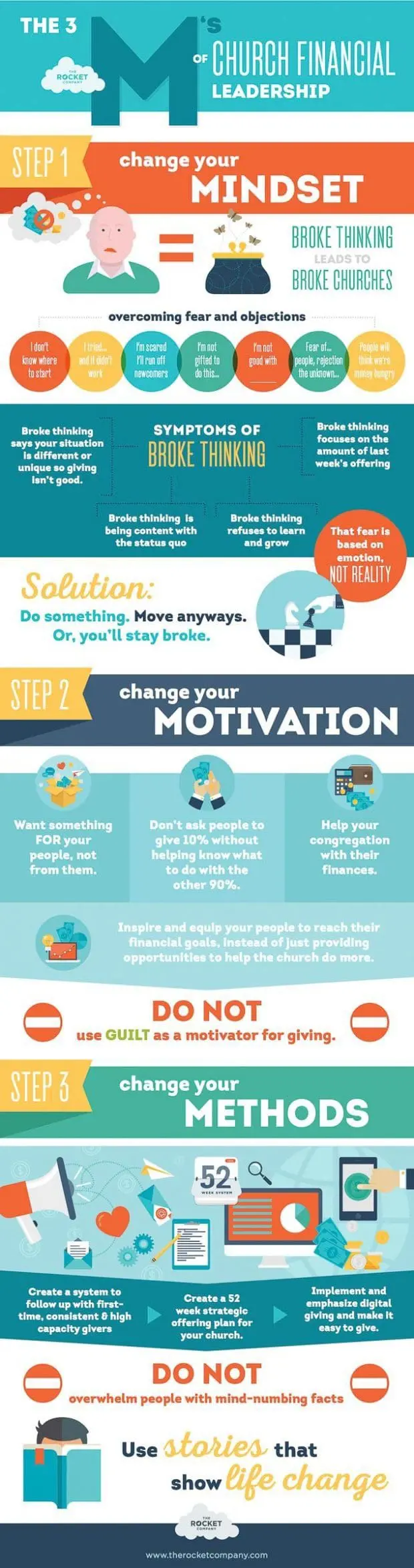
Change your mindset and your motivation and you will change your methods.
11. Personal Finances Are In Chaos
Pastors live with the reality that the Word works in them before it works in their church members.
So whenever you preach on a topic you have to wrestle with it at a personal level.
Plus you know that a sermon with personal stories always kicks a bigger punch than a sermon devoid of illustration.
When your finances are a mess you are less likely to wade into this topic.
Speaking about living within your means when your credit card debt is out of control is hypocrisy.
Challenging people to give generously when you are a tight-fisted shepherd is not going to fly. You will find it difficult in the extreme to develop a culture of generosity.

12. Reaction to a Bad Experience
Some pastors have been in churches or movements that have gone overboard with an emphasis on money.
Once bitten, twice shy is their motto. They react with rejection and avoidance rather than learning from their experience.
Dwelling on the past is rarely a way to move into your future.
13. False Guilt Over Salary
Now, this point is not readily acknowledged.
When pastors are raising resources they are also the beneficiaries of those resources, especially in regards to their salary.
Staff salaries are a significant and legitimate part of a church’s budget. Churches generally aim to expend 40–55% of their church budget on salaries. Paying pastors and staff for their work is good stewardship, and pastors should not feel guilty because some of the money raised supports their ministry.
Pastors can get skittish about raising money because they know that this money will be used to pay them a salary.
False guilt can rule a pastor’s mind and thus they avoid preaching on money.
This can also spill over into mission’s money which is used to send the pastor overseas on a mission trip. While these trips are rarely as glamorous as they might appear, the pastor can experience guilt over spending those monies on their travel expenses.
14. Insufficient Study
Some pastors haven’t given serious time to study the many references to money in the Scriptures.
While they may have perused various texts they haven’t given contemplative time to understand the economics of the Kingdom and subsequently haven’t formulated a personal philosophy on money.
The Scriptures are replete with stories regarding money and one-off texts outlining healthy attitudes towards money which should demand the attention of every pastor.
Jesus spent a considerable amount of time talking about money and its impact on the human heart.
He commanded us never to serve mammon but to serve Him.
His insights into money reflect the wisdom of Solomon which we find in proverbs.
I doubt that there’s a book of the Bible that doesn’t touch on the topic of money.
Therefore, pastors need to get out their study tools and delve into this extensive topic otherwise they will lack the wisdom to disciple their church into the path of wisdom.
My Number One Tip on Sermons on Giving
I heard it many years ago from John Avanzini and it’s been a guiding light.
Preach to get money to people not money from people
Don’t avoid this topic because it’s difficult, delicate, or dangerous.
Instead, courageously approach the topic from an angle of how you can help your people handle their money in a God-honouring way.
Help them to work out how to get more money in their world through correct attitudes, right work practices, saving, budgeting, business building, and so on.
Don’t focus on giving. Preach to get money to people.
Help people handle their money to the glory of God. This will help you grow a healthy church.
Discuss This With Your Leaders
- Which of these 14 reasons is holding us back from teaching about money?
- What biblical money topic do our people most need help with?
- When will we teach it, and what practical step will we invite people to take?
Choose your next teaching step and put it in your preaching plan. Use the best practices in church finances to connect your teaching with the way your church handles money.
Frequently Asked Questions
How often should pastors preach about money?
Often enough to help your people grow in stewardship. Include money in your regular teaching plan rather than addressing it only when the church needs funds.
How can I present a financial need confidently?
Explain the purpose, what the giving will accomplish and how people can participate. Prepare your words and speak clearly. For a larger project, plan a thoughtful annual giving campaign.
How can I teach generosity without sounding as though I’m only asking for money?
Help people understand how to honour God with their whole financial world. Teach generosity alongside budgeting, saving, work and contentment. Your aim is to disciple people, as well as resource the church’s mission.
Where should I start if I lack confidence?
Study a biblical passage carefully, identify how it will help your people and prepare one practical application. Build your own financial understanding and draw on your experience as you teach.
For practical help with preparing clear, effective sermons, explore my book Preaching in a Whatever World.